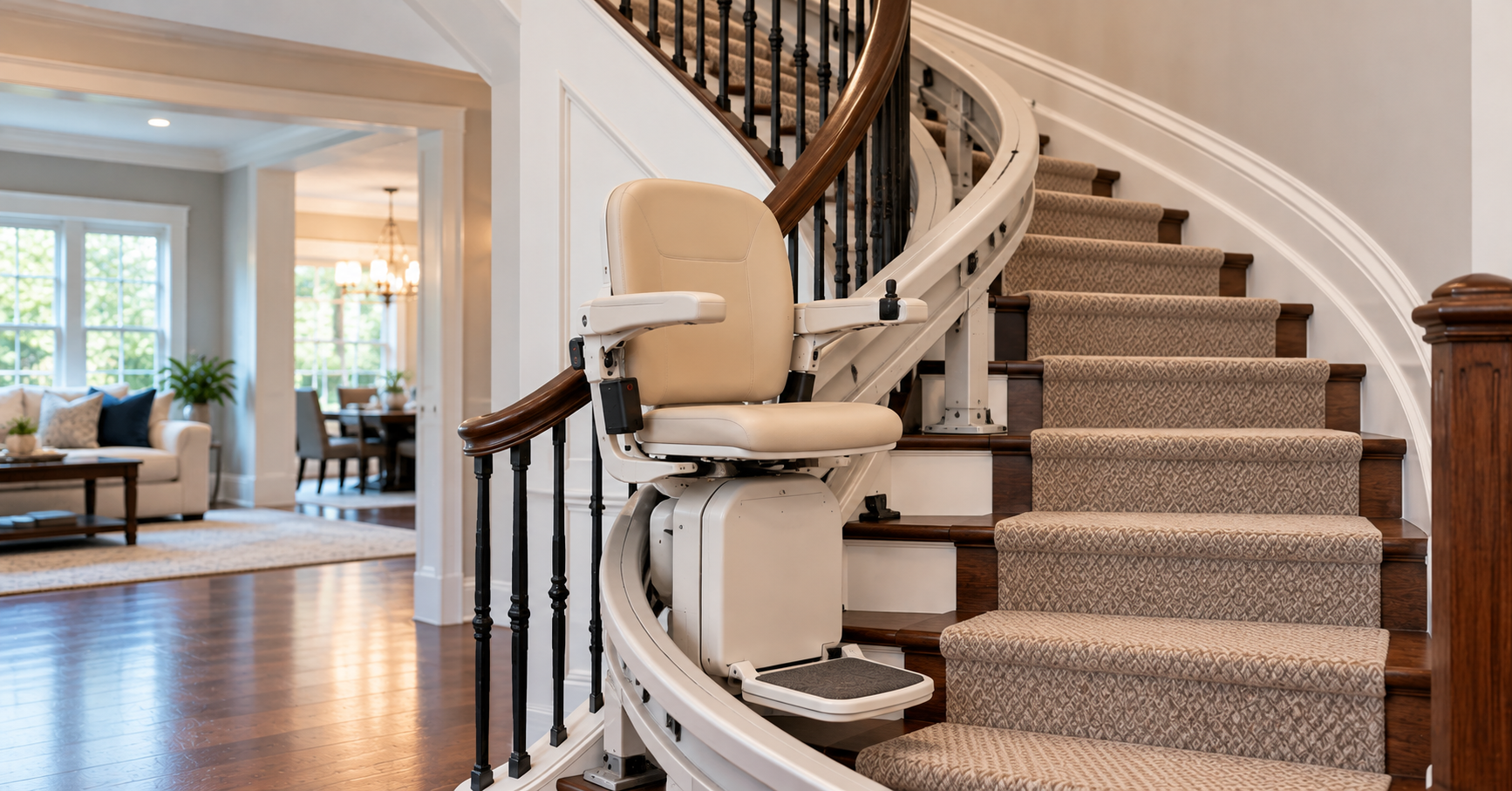

Same-day stairlift installation means a technician measures your staircase, mounts a rail, and has a working stairlift running in a single visit, usually in two to four hours. It works because most straight staircases can use a pre-built rail that’s cut to length on site, so there’s no waiting weeks for custom fabrication.
For a family whose mother just came home from the hospital with a new hip, that speed matters. She can sleep in her own upstairs bedroom tonight instead of on the living room couch. This guide explains which stairs qualify, what happens before and during the install, the safety features to expect, and how to pay for it.
Which Staircases Qualify for Same-Day Stairlift Installation
Straight staircases are the ones that qualify. If you can stand at the bottom step and see the top step in one uninterrupted line, your stairs are almost certainly a candidate.
That covers the typical 13-step run between the first and second floors of a colonial, a split-level’s short half-flight, and most basement stairs. Installers keep straight rails in stock in standard lengths and trim them to fit.
Curved staircases, stairs with a landing that changes direction, and spiral stairs are different. Each needs a rail bent to match the exact geometry of the steps. That rail is built at a factory after measurements or a photo survey, and the wait is usually several weeks. A straight-rail solution can sometimes bridge the gap: two separate straight lifts, one on each section of an L-shaped staircase, are often installed quickly while still being cheaper than a curved unit.
Before Installation: The In-Home Assessment
A quick assessment confirms the lift will fit and work safely. Many companies combine it with the installation itself, which is what makes a same-day timeline possible. The technician checks a few specific things:
- Stair width. Most straight stairlifts need roughly 28 to 30 inches of clear width, though slim models fit narrower stairs.
- Stair length and angle. These determine the rail length and confirm the incline falls within the lift’s rated range.
- Power source. A standard household outlet near the top or bottom of the stairs is all most battery-powered lifts need.
- Rider needs. Weight, height, and mobility affect the seat choice. Standard models typically carry up to about 300 pounds, while heavy-duty versions handle more.
- Obstacles. Doorways, radiators, or a door that swings over the bottom step can change where the rail ends.
If you have stair runners or carpet, mention it when you book. The rail mounts through carpet without a problem, but loose treads should be fixed first.
Installation Day, Step by Step
A straight stairlift attaches to the stair treads, not the wall. That single design choice explains why the job is fast and why it leaves your walls untouched.
- Cut the rail. The installer trims an aluminum or steel rail to the exact length of your staircase, often in the driveway or garage.
- Mount the brackets. Small support feet are screwed into several treads along the staircase. Nothing is anchored into drywall or plaster.
- Attach the rail. The rail bolts onto those brackets and is leveled so the chair travels smoothly.
- Fit the carriage and seat. The motor unit slides onto the rail, and the seat, footrest, and armrests attach to it.
- Set the charging points. Charging stations go at the top and bottom of the rail, and the lift plugs into your outlet.
- Test the ride. The technician runs the lift up and down repeatedly, checking speed, braking, and every sensor.
Most homeowners are surprised by how little mess there is. A drop cloth, a cordless drill, and a few hours usually cover it.
Safety Features and the Handover Walkthrough
Modern stairlifts are built to stop before anything goes wrong. Before the technician leaves, they’ll show the rider and family how each safety feature works.
Expect a retractable seatbelt and a swivel seat that locks at the top, so the rider never has to step off facing the stairs. Obstruction sensors on the footrest and carriage halt the lift if a slipper, a shopping bag, or the family cat is in the way. A key switch prevents grandchildren from treating it as a ride.
Battery backup is especially valuable. If the power goes out during a summer storm, the lift keeps working for a number of trips. Two wireless call remotes let someone send the chair up or down when it’s parked at the wrong end.
The walkthrough ends with the rider making a few trips while the technician watches. That practice builds confidence on day one.
Stairlift Cost and Funding Options
A new straight stairlift typically costs a few thousand dollars installed, while curved models often run two to three times as much. Reconditioned units and rental programs can bring the price down further, which suits short recoveries. Medicare generally does not cover stairlifts. Other sources may help:
- Medicaid waiver programs in many states cover home modifications for eligible residents.
- VA benefits, such as the HISA grant, can assist qualifying veterans.
- IRS medical expense deductions may apply when a doctor recommends the lift; IRS Publication 502 has the details.
Ask for a written quote that includes installation, warranty length, and service response times. A low sticker price means little if a repair takes two weeks.
Book Your Same-Day Stairlift Installation Today
Stairs shouldn’t decide which rooms of your home you can use. With a straight staircase, a standard outlet, and a single appointment, a stairlift can be running before dinner.
Start with a free in-home assessment. A certified technician will measure your stairs, recommend the right model for the rider, and, in many cases, install it the same day. You’ll get a full safety walkthrough and a clear warranty before they leave. Call now or request your free quote online to check same-day availability. Getting upstairs safely again can start today.